
**What is Mounjaro?** It’s the brand name for tirzepatide, a once-weekly injection used to treat obesity and type 2 diabetes. It acts on two natural gut hormones that control appetite and blood sugar. In clinical trials, it has led to some of the largest average weight losses seen with any medicine. This guide explains how it works, who can use it, how it’s taken and what results to expect. It also covers side effects and safety, based on the latest 2026 UK guidance.
Key takeaways
- Mounjaro (tirzepatide) is a prescription-only weekly injection made by Eli Lilly.
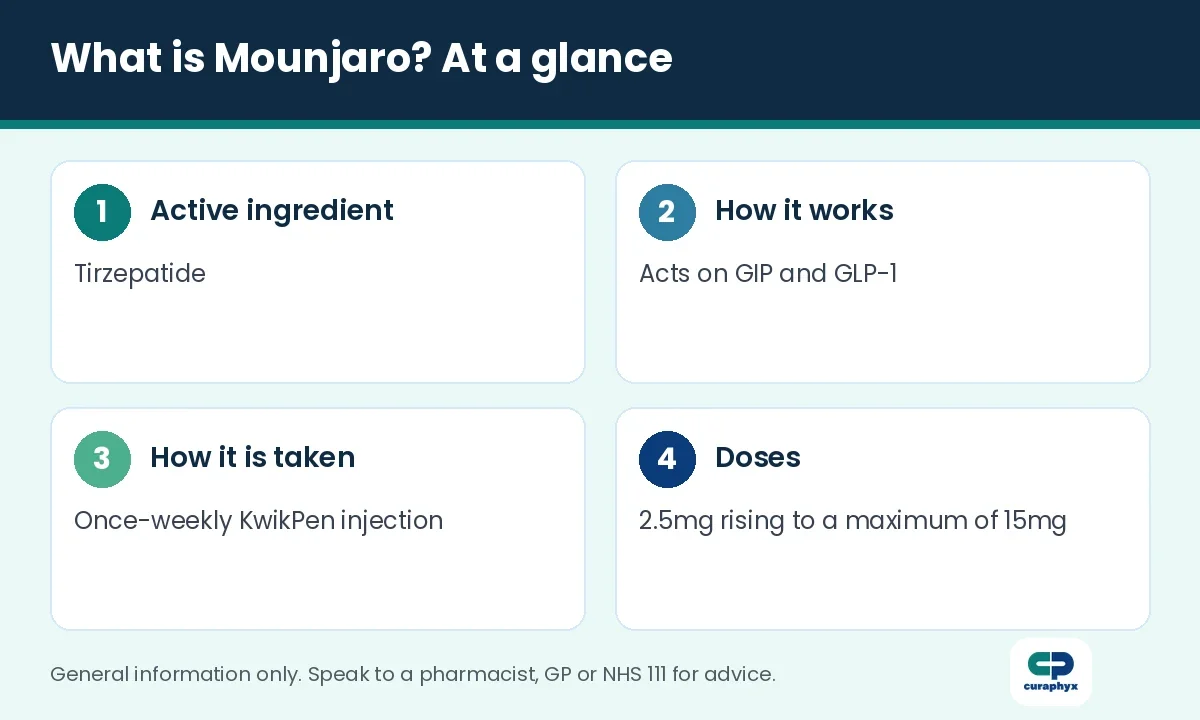
- It’s the first licensed medicine to act on both GIP and GLP-1 hormone receptors.
- It’s licensed for weight management in adults with a BMI of 30 or more, or 27 or more with a weight-related condition.
- Treatment starts at 2.5mg and can rise in steps to a maximum of 15mg.
- In trials, adults lost an average of 15% to 21% of their body weight over 72 weeks.
- The most common side effects affect the stomach and gut, and usually ease over time.
What Is Mounjaro and Who Makes It?
Mounjaro is a medicine that contains the active ingredient tirzepatide. The pharmaceutical company Eli Lilly makes it. You inject it under the skin once a week using a pre-filled pen called a KwikPen.
At first, Mounjaro had a licence to treat type 2 diabetes only. Then, after large trials showed major weight loss, regulators extended the UK licence to weight management. Today, it’s one of the most widely used weight loss medicines in the UK, both privately and on the NHS.
It’s a prescription-only medicine. That means a doctor, nurse or pharmacist prescriber must check it’s safe and suitable for you first.
How Does Mounjaro Work?
Your gut releases hormones called incretins after you eat. Two of the most important are GLP-1 and GIP. Together, they help control blood sugar and tell your brain you’ve had enough food.
Tirzepatide copies both hormones. That’s why experts call it a dual GIP and GLP-1 receptor agonist. Older medicines such as semaglutide only act on GLP-1.
Effects on appetite
Mounjaro acts on areas of the brain that control hunger. As a result, many people feel full sooner, feel less hungry between meals and think about food less often. It also slows how quickly your stomach empties, so meals keep you satisfied for longer.
Effects on blood sugar
When blood sugar is high, tirzepatide helps your pancreas release more insulin. It also lowers glucagon, a hormone that raises blood sugar. Because these effects depend on your blood sugar level, Mounjaro rarely causes low blood sugar on its own. However, the risk rises if you also take insulin or a sulfonylurea.
Why a dual action matters
This dual action helps explain why the same medicine can treat both type 2 diabetes and obesity. Moreover, in SURMOUNT-5, people taking tirzepatide lost more weight on average than those taking semaglutide. You can read more in our comparison with Wegovy.
What Is Mounjaro Licensed For?
In the UK, Mounjaro has two main uses.
**Weight management.** It’s licensed for adults alongside a reduced-calorie diet and more physical activity. You need a BMI of:
- 30 or more, or
- 27 to 30 with at least one weight-related condition, such as high blood pressure, abnormal cholesterol, obstructive sleep apnoea, heart disease, prediabetes or type 2 diabetes.
**Type 2 diabetes.** It’s also licensed to improve blood sugar control in adults with type 2 diabetes. Since 2026, the licence also covers children aged 10 and over with type 2 diabetes, at doses up to 10mg. In addition, the 2026 product information says Mounjaro can help prevent heart disease in adults with type 2 diabetes. This follows a large heart outcomes trial called SURPASS-CVOT.
On the NHS, the criteria for weight loss are stricter. NICE recommends it for adults with a BMI of at least 35 and at least one weight-related condition. Meanwhile, NHS England is rolling it out in phases, starting with people who have the highest needs. Our eligibility guide explains this in detail.
How Is Mounjaro Taken?
You inject Mounjaro once a week, on the same day each week. You can take it at any time of day, with or without food. Each KwikPen holds four weekly doses, but you’ll need to get pen needles separately.
You inject it into your tummy or thigh. Someone else can also inject it into the back of your upper arm. Change the injection site each week to reduce skin irritation. For full instructions, see our step-by-step injection guide.
Mounjaro doses
Treatment always starts low. This gives your body time to adjust and reduces side effects.
| Stage | Weekly dose | How long |
|---|---|---|
| Starting dose | 2.5mg | 4 weeks |
| First increase | 5mg | At least 4 weeks |
| Further increases | 7.5mg, 10mg, 12.5mg | At least 4 weeks at each |
| Maximum dose | 15mg | As long as prescribed |
The maintenance dose for weight loss is 5mg, 10mg or 15mg. Your prescriber will choose the dose that works best for you with the fewest side effects. Our dose guide covers each strength in more detail.
If you miss a dose
If it’s been four days or less since your missed dose, take it as soon as you remember. If it’s been more than four days, skip it and take your next dose on your usual day. Never take two doses within three days of each other.
How Effective Is Mounjaro?
Mounjaro’s results come from a large trial programme called SURMOUNT.
- **SURMOUNT-1:** adults without diabetes lost an average of 15.0%, 19.5% and 20.9% of their weight on 5mg, 10mg and 15mg over 72 weeks. By contrast, the placebo group lost 3.1%.
- **SURMOUNT-2:** adults with type 2 diabetes lost an average of 12.8% to 14.7%, compared with 3.2% on placebo.
- **SURMOUNT-3:** after a 12-week diet and exercise programme, people lost a further 18.4% on average.
- **SURMOUNT-4:** people who stopped treatment regained much of the weight. Meanwhile, those who continued kept losing weight.
These are average results. Some people lose more, while others lose less. For more on what’s realistic, see our guide to how much weight people lose. Weight loss usually builds over months, so our guide on how long it takes to work explains the timeline.
What Are the Side Effects of Mounjaro?
Like all medicines, Mounjaro can cause side effects. Most affect the digestive system. They’re usually mild to moderate and tend to happen when you start or increase your dose.
Very common side effects include:
- feeling sick (nausea)
- diarrhoea
- being sick (vomiting)
- constipation
- stomach pain
Common side effects include indigestion, bloating, burping, wind, reflux, reduced appetite, tiredness, dizziness, hair loss and injection site reactions.
Serious side effects
Rarely, Mounjaro can cause more serious problems. In January 2026, the MHRA strengthened its warning about acute pancreatitis after reports of severe and fatal cases. Call 111 or get urgent help if you have severe stomach pain that doesn’t go away, particularly if it spreads to your back.
Other serious risks include gallbladder problems, dehydration that affects the kidneys and severe allergic reactions. Our full guide to side effects explains how to manage each one.
Who Should Not Take Mounjaro?
Mounjaro isn’t suitable for everyone. You shouldn’t use it if you’re allergic to tirzepatide or any of the ingredients.
You also shouldn’t use it if you’re pregnant. If you’re planning a pregnancy, stop at least one month beforehand. NHS and MHRA advice is not to use it while breastfeeding either.
Your prescriber will take extra care if you have:
- had pancreatitis
- gallbladder disease
- severe stomach or bowel problems, such as gastroparesis
- diabetic eye disease
- kidney problems
- a history of an eating disorder
Before surgery or a procedure under sedation, tell the team that you take Mounjaro. This is because slower stomach emptying can raise the risk of breathing in stomach contents.
Mounjaro and Contraception
Mounjaro can make the contraceptive pill less effective. This is most likely in the first four weeks of treatment and for four weeks after each dose increase. During these times, use a condom as well, or switch to a non-oral method such as a coil or implant. Our medicine interactions guide covers this and other important interactions.
How Long Do You Take Mounjaro For?
Mounjaro is usually a long-term treatment. Your prescriber should review your progress regularly. If you’ve lost less than 5% of your starting weight after six months on your highest tolerated dose, they’ll discuss whether to continue.
Stopping often leads to weight regain, as SURMOUNT-4 showed. That’s why diet, activity and a plan for the future matter. Eating well also helps with side effects, so our guide to what to eat on treatment offers practical tips.
Getting Mounjaro Safely
Mounjaro is only legally available on prescription from a registered pharmacy. The MHRA warns against buying weight loss injections from social media, beauty salons or unregulated websites. In February 2026, it even reported fake Mounjaro 15mg pens supplied through one UK online pharmacy.
Genuine Mounjaro comes as a pre-filled KwikPen with a patient leaflet. In contrast, the MHRA says powder vials that you mix yourself are not authorised. If something looks wrong, don’t use it.
Frequently Asked Questions
Is Mounjaro a GLP-1?
Partly. Mounjaro acts on GLP-1 receptors, but it also acts on GIP receptors. That’s why it’s described as a dual agonist rather than just a GLP-1 medicine.
Is Mounjaro the same as Wegovy?
No. Wegovy contains semaglutide, which only acts on GLP-1. Both are weekly injections, but they’re different medicines with different doses.
Can I take Mounjaro if I don’t have diabetes?
Yes, if you meet the licensed BMI criteria and a prescriber decides it’s suitable. Many people use it for weight management without having diabetes.
Is Mounjaro available on the NHS?
Yes, for some people. NHS England is rolling it out in phases through GPs and specialist services. The criteria are stricter than for private treatment.
What happens if I stop Mounjaro?
Your appetite is likely to return, and many people regain weight. Talk to your prescriber before stopping. If you have type 2 diabetes, don’t stop suddenly without medical advice.
Summary
So, what is Mounjaro? It’s a weekly tirzepatide injection that acts on two gut hormones to reduce appetite and improve blood sugar control. It has shown large average weight losses in trials, but it isn’t right for everyone. It also works best alongside a healthier diet and more activity. Above all, a qualified prescriber should check it’s safe for you before you start.
Why Choose CuraPhyx Pharmacy?
CuraPhyx Pharmacy is a UK pharmacy built around safe, professional care. If you’re thinking about whether Mounjaro might be suitable for you, this is what you can expect from us:
- First, a qualified pharmacist prescriber reviews every request for a prescription medicine.
- We check your answers, weight and medical history carefully before making any decision.
- Medicines only leave the pharmacy after clinical approval. If treatment isn’t right for you, we’ll explain why and won’t supply it.
- We send approved orders across the UK in discreet packaging.
- Our team is also happy to help with questions at info@curaphyx.co.uk.
You can find out more about how our weight loss service works, including the checks involved, before you decide whether it’s right for you.
Sources and Further Reading
We checked this article against the following sources in October 2026:
- Tirzepatide (NHS)
- Summary of product characteristics (tirzepatide KwikPen) (emc)
- Patient information leaflet (tirzepatide KwikPen) (emc)
- Tirzepatide for managing overweight and obesity (NICE TA1026)
- Interim commissioning guidance for tirzepatide (NHS England)
- GLP-1 medicines for weight loss and diabetes: what you need to know (MHRA)
- Strengthened warnings on acute pancreatitis (January 2026) (MHRA Drug Safety Update)
- GLP-1 medicines and contraception (MHRA)
- Aspiration risk during anaesthesia or deep sedation (MHRA Drug Safety Update)
- Falsified tirzepatide 15mg pens (MHRA Drug Safety Update)
- Jastreboff AM et al. Tirzepatide once weekly for the treatment of obesity (SURMOUNT-1). N Engl J Med, 2022
- Garvey WT et al. Tirzepatide in people with obesity and type 2 diabetes (SURMOUNT-2). Lancet, 2023
- Wadden TA et al. Tirzepatide after intensive lifestyle intervention (SURMOUNT-3). Nat Med, 2023
- Aronne LJ et al. Continued treatment with tirzepatide for maintenance of weight reduction (SURMOUNT-4). JAMA, 2024
- Aronne LJ et al. Tirzepatide compared with semaglutide for obesity (SURMOUNT-5). N Engl J Med, 2025
- Tirzepatide (BNF)
This article is for general information only. It doesn’t replace advice from your GP, pharmacist or prescriber. Mounjaro is a prescription-only medicine, so a prescriber must decide whether it’s suitable for you. Always read the patient information leaflet that comes with your medicine. Last reviewed: October 2026.