**GLP-1 weight loss** medicines have changed how obesity is treated in the UK. They include weekly injections such as Wegovy and Mounjaro, and newer daily tablets. Used alongside healthier eating and more activity, they can help many people lose a meaningful amount of weight. This guide explains how they work, which ones are licensed, who may be suitable, the side effects and how to use them safely.
Key takeaways
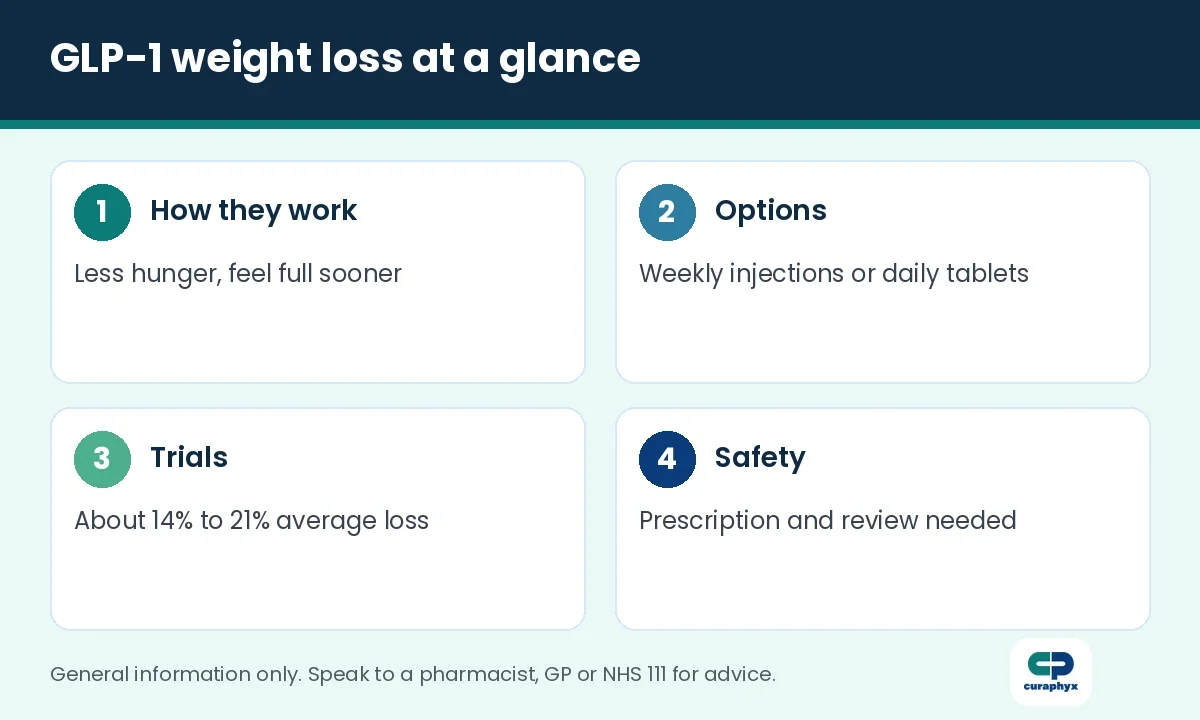
- GLP-1 medicines copy a natural gut hormone that reduces hunger and helps you feel full.
- UK-licensed options include Wegovy pens and tablets, Mounjaro, liraglutide and Foundayo.
- In major trials, average weight loss ranged from about 14% to 21%, depending on the medicine and dose.
- They’re prescription-only, and a prescriber must check they’re safe for you.
- Stomach side effects are common, especially while the dose is going up.
- Weight often returns after stopping, so long-term habits matter.
What Is GLP-1?
GLP-1 stands for glucagon-like peptide-1. It’s a hormone your gut releases after you eat. It has several natural jobs, such as:
- signalling to your brain that you’re full
- slowing how quickly food leaves your stomach
- helping your body release insulin when blood sugar is high
- lowering glucagon, a hormone that raises blood sugar
However, natural GLP-1 only lasts a few minutes in the body. By contrast, GLP-1 medicines are designed to last much longer, so their effects continue for a day or a week.
How GLP-1 Weight Loss Medicines Work
GLP-1 medicines are also called GLP-1 receptor agonists. This means they attach to the same receptors as the natural hormone and switch them on.
According to the semaglutide product information, these medicines act on areas of the brain that control appetite and food intake. In an early study, people on semaglutide 2.4mg ate about 35% fewer calories at a free-choice meal than those on placebo. They also reported less hunger, fewer food cravings and better control of eating.
In addition, slower stomach emptying adds to this feeling of fullness. As a result, many people find they’re satisfied with smaller portions and think about food less often.
Mounjaro works slightly differently, though. Its active ingredient, tirzepatide, acts on GLP-1 receptors and also on receptors for a second gut hormone, called GIP. That’s why it’s sometimes called a dual agonist.
GLP-1 Weight Loss Medicines Licensed in the UK
Several medicines are licensed for weight management in adults. Each has its own dosing schedule, so a prescriber decides which, if any, is suitable.
| Medicine | How it’s taken | How it works |
|---|---|---|
| Wegovy pen | Once a week | GLP-1 |
| Wegovy tablets | Once a day | GLP-1 |
| Mounjaro pen | Once a week | GIP and GLP-1 |
| Daily GLP-1 pen | Once a day | GLP-1 |
| Foundayo | Once a day, by mouth | GLP-1 |
Semaglutide
Wegovy injections start at 0.25mg a week and rise every 4 weeks to the usual maintenance dose of 2.4mg. Since 2026, some adults with obesity can move up to 7.2mg weekly. The MHRA then approved Wegovy tablets in June 2026. They start at 1.5mg once a day and increase monthly to 25mg.
Tirzepatide
Mounjaro starts at 2.5mg once a week. After that, the dose goes up in 2.5mg steps, at least 4 weeks apart, to a maintenance dose of 5mg, 10mg or 15mg.
Liraglutide and orforglipron
Liraglutide is an older medicine that you inject once a day. Orforglipron (Foundayo) is a daily GLP-1 tablet that the MHRA authorised in August 2026. Unlike Wegovy tablets, it can be taken at any time of day without food or water restrictions.
How Effective Is GLP-1 Weight Loss Treatment?
Large clinical trials show that these medicines, combined with diet and activity support, lead to substantial weight loss on average:
| Trial | Medicine | Average weight loss | Placebo |
|---|---|---|---|
| STEP 1 (68 weeks) | Wegovy 2.4mg pen | 14.9% | 2.4% |
| OASIS 4 (64 weeks) | Wegovy 25mg tablet | 13.6% | 2.2% |
| SURMOUNT-1 (72 weeks) | Mounjaro 15mg | 20.9% | 3.1% |
In addition, the SELECT trial looked at adults with heart disease and a high BMI. It found that Wegovy 2.4mg lowered the risk of heart attack, stroke and death from heart disease.
However, these are averages. Some people lose more and others lose less, so trial results can’t predict how one person will respond. Also, people in trials received regular diet and activity support.
Who Can Have GLP-1 Weight Loss Medicines?
The product licence
For private prescribing, the licence for Wegovy and Mounjaro covers adults with:
- a BMI of 30 or more (obesity), or
- a BMI of 27 to 29.9 (overweight) plus at least one weight-related health problem, such as high blood pressure, type 2 diabetes or sleep apnoea
On the NHS
NHS criteria are stricter, though. For example, NICE recommends Wegovy within specialist weight management services, for a maximum of 2 years. Mounjaro is being rolled out in phases, starting with people who have the highest BMI and several weight-related conditions. Lower BMI thresholds usually apply to people from South Asian, Chinese, other Asian, Middle Eastern, Black African or African-Caribbean backgrounds.
At the moment, Wegovy tablets and Foundayo aren’t available on the NHS.
Who shouldn’t use them
These medicines aren’t suitable for everyone. For example, they shouldn’t be used in pregnancy or while breastfeeding. Prescribers also take extra care in some cases. For example, they’ll check if you’ve had pancreatitis, gallbladder problems or an eating disorder. Severe stomach problems, such as gastroparesis, need care too. Our GLP-1 eligibility guide explains the checks in more detail.
Common Side Effects
Stomach side effects are the most common. For example, many people feel sick, have diarrhoea or get constipated. Some also have stomach pain, indigestion or reflux, and a few are sick. These are mainly seen while the dose is going up, and they often ease over time. Headaches, tiredness and dizziness are also common. Our side effects guide has practical tips for managing them.
Serious Risks to Know About
Serious side effects are uncommon. Even so, it’s important to know the warning signs:
- **Pancreatitis.** In 2026, the MHRA strengthened warnings about acute pancreatitis with these medicines. Get urgent help for severe tummy pain that won’t go away, which may spread to your back.
- **Gallbladder problems.** Gallstones are a common side effect, especially with rapid weight loss.
- **Dehydration.** Vomiting or diarrhoea can cause dehydration, which can affect your kidneys.
- **Anaesthesia.** Tell your care team if you need surgery or sedation, because slower stomach emptying can increase the risk of breathing in stomach contents.
- **Eyesight.** Rarely, semaglutide has been linked to a type of sudden sight loss called NAION. Get urgent help if your vision suddenly worsens.
GLP-1 Weight Loss and Contraception
The MHRA advises women who could become pregnant to use effective contraception while taking these medicines. Mounjaro can make the contraceptive pill less effective, especially after starting and after each dose increase. Also, severe vomiting or diarrhoea can stop any pill working properly. You’ll need to stop treatment before a planned pregnancy. The gap is at least 2 months for semaglutide and at least 1 month for tirzepatide.
Getting Started With GLP-1 Weight Loss Treatment
If you’re considering treatment, the first step is a full assessment. During this, a prescriber will ask about your weight, height, health conditions and current medicines. They may also ask you to confirm your weight, for example with a photo or video.
Once you start, the dose increases slowly to help your body adjust. Our guide to your first 12 weeks explains what to expect. It also helps to plan meals around smaller portions. Our UK meal ideas can help with that.
After that, your prescriber should review your progress regularly. If treatment isn’t working well enough, they’ll discuss whether to continue.
Lifestyle Still Matters
Of course, GLP-1 medicines work best alongside healthy habits. NICE says these medicines should be used with a lower-calorie diet and more activity. The NHS recommends:
- a balanced diet based on the Eatwell Guide, with enough protein, fruit, vegetables and fibre
- at least 150 minutes of moderate activity a week
- muscle-strengthening activities on at least 2 days a week
- drinking enough fluids, especially if you have stomach side effects
Strength exercise is especially useful, because it helps you keep muscle while you lose fat.
What Happens When You Stop?
Unfortunately, weight often comes back after stopping. In the STEP 4 trial, people who switched from semaglutide to placebo regained much of their lost weight within a year. Similarly, the SURMOUNT-4 trial found that people who stopped tirzepatide regained a large part of their weight.
So, talk to your prescriber before stopping. Building long-term eating, activity and sleep habits during treatment gives you the best chance of keeping your progress.
Buying GLP-1 Medicines Safely
The MHRA warns that fake weight loss medicines are sold online and through social media. These fakes may contain the wrong ingredient, the wrong dose or harmful substances. So, only use a GLP-1 medicine prescribed for you and supplied by a registered pharmacy. Never buy them from beauty salons, social media sellers or websites that don’t ask about your health.
Frequently Asked Questions
How quickly does GLP-1 weight loss start?
Many people notice a smaller appetite within the first few weeks. However, weight loss is usually gradual, because the dose rises slowly over several months.
Are GLP-1 tablets as effective as injections?
Trials use different designs, so direct comparisons are difficult. In OASIS 4, semaglutide 25mg tablets led to 13.6% average weight loss over 64 weeks. A prescriber can explain which form may suit you.
Can I get GLP-1 weight loss medicine on the NHS?
Possibly, if you meet NICE criteria. Even then, NHS access is limited and varies by area. Your GP can tell you about local services.
Is GLP-1 weight loss treatment lifelong?
Not necessarily, but many people need long-term treatment to keep weight off. That’s because appetite often returns when treatment stops. Your prescriber will review the benefits and risks with you over time.
Summary
GLP-1 weight loss medicines copy a natural gut hormone that reduces hunger and slows digestion. In trials, they led to average weight loss of about 14% to 21%. They’re prescription-only and not suitable for everyone, and stomach side effects are common at first. Used with a healthy diet, regular activity and ongoing review, they can be an effective part of long-term weight management.
Why Choose CuraPhyx Pharmacy?
CuraPhyx Pharmacy is a UK pharmacy built around safe, professional care. If you’re thinking about GLP-1 medicines, this is what you can expect from us:
- First, a qualified pharmacist prescriber reviews every request for a prescription medicine.
- We check your answers, weight and medical history carefully before making any decision.
- Medicines only leave the pharmacy after clinical approval. If treatment isn’t right for you, we’ll explain why and won’t supply it.
- We send approved orders across the UK in discreet packaging.
- Our team is also happy to help with questions at info@curaphyx.co.uk.
You can find out more about how our weight loss service works, including the checks involved, before you decide whether it’s right for you.
Sources and Further Reading
We checked this article against the following sources in October 2026:
- Semaglutide (NHS)
- FlexTouch semaglutide pen: summary of product characteristics (updated September 2026) (emc)
- Semaglutide tablets for weight management: summary of product characteristics (emc)
- Tirzepatide (Mounjaro) (NHS)
- Semaglutide for managing overweight and obesity (NICE TA875)
- Tirzepatide for managing overweight and obesity (NICE TA1026)
- Overweight and obesity management (NICE NG246)
- First semaglutide tablet approved in the UK (June 2026) (MHRA)
- Orforglipron (Foundayo) authorised in the UK (August 2026) (MHRA)
- What you need to know about these medicines (MHRA)
- Strengthened warnings on acute pancreatitis (January 2026) (MHRA Drug Safety Update)
- GLP-1 medicines and contraception (June 2025) (MHRA)
- Wilding JPH et al. Once-weekly semaglutide in adults with overweight or obesity (STEP 1). N Engl J Med, 2021
- Wharton S et al. Oral semaglutide at a dose of 25 mg in adults with overweight or obesity (OASIS 4). N Engl J Med, 2025
- Jastreboff AM et al. Tirzepatide once weekly for the treatment of obesity (SURMOUNT-1). N Engl J Med, 2022
- Lincoff AM et al. Semaglutide and cardiovascular outcomes in obesity without diabetes (SELECT). N Engl J Med, 2023
- Rubino D et al. Continued weekly semaglutide vs placebo on weight loss maintenance (STEP 4). JAMA, 2021
- Aronne LJ et al. Continued treatment with tirzepatide for maintenance of weight reduction (SURMOUNT-4). JAMA, 2024
This article is for general information only. It doesn’t replace advice from your GP, pharmacist or prescriber. Wegovy and other GLP-1 medicines are prescription-only medicines, so a prescriber must decide whether they’re suitable for you. Always read the patient information leaflet that comes with your medicine. Last reviewed: October 2026.